Thursday, September 13, 2012

Three Northern Islets

Pengjia, seen from path to lighthouse.
I sensibly resisted the temptation to make a claim
on behalf of any additional foreign power!
Just back from an excellent trip with Taipei Bird Society to some islands north of Taiwan: Pengjia Islet (彭佳嶼); Huaping Islet (花瓶嶼); and Mianhua Islet (棉花嶼). Pengjia Islet (I would call it more an ‘island’ rather than ‘islet’) was visited a few days earlier by the Taiwan (ROC) president Ma Ying-jeou where he made comments about territorial disputes in the region - and in particular the Tiaoyutais (aka Diaoyu/Senkaku Islands 釣魚台). By my standards of ‘overwhelming common sense’ these islands I visited, third of the way to the Tiaoyutais, are undeniably part of Taiwan. Not contested.

Sometimes known as the “Three Northern Islets (北方三島)”, access is heavily restricted - we had special permission to land on the largest (covering over 1km2) of the islands - Pengjia. A small number of personnel from the Coast Guard, Customs (managing the very nice lighthouse), and Weather Bureau are comfortably based there. The establishment of a national marine park has been mooted.


Brown Booby
We traveled the roughly 33 nautical miles (56 km) from Keelung by fishing boat in 3 hours. We carefully circled the two smaller islands (Huaping and Mianhua) getting fantastic views of Boobies. We only had a couple hours on Pengjia in the blazing sun. Am sure many more species could have been found with a bit more time...and much less sun.

The bird of the trip for me is certainly the Brown Booby. Great views several times especially at Mianhua cliffs.


Birds seen on or near these islands:

Bulwers Petrel - around 3 or 4 seen
Short-tailed Shearwater - 1 seen fairly well
Swinhoe’s Storm-Petrel - just about-tickable view of 1
Brown Booby - around 50 at several locations, fantastic views at Mianhua
Grey Heron - 1
Little Egret - several
Cattle Egret - several
Crested Serpent-Eagle - 1 at Keelung Harbor
Chinese Goshawk - 1 seen on Pengjia, thousands reported in Kenting today.
Peregrine Falcon - 1 recorded, forget where

On our mighty craft!
Grey-tailed Tattler - 3 on Pengjia (was hoping they would turn out to be Wandering T.)
Wood Sandpiper - 1 seen by others
Whimbrel - 2 or 3
Red-necked Phalarope - over 20 at different times on the sea.
Snipe species?
Brown Noddy - 3 seen. Pleased!
Bridled Tern - several
Black-naped Tern
Rock Pigeons - several on Pengjia.
Eurasian Magpie - reported by others
Barn Swallow - several
Pacific Swallow - at least 1
Gray-streaked Flycatcher - 2 gave good views
Blue Rock-Thrush - several gave good views
White-shouldered Starling - several on Pengjia
Yellow Wagtail - several, forgot to check race
Gray Wagtail - at least 1
Also Light Vented Bulbul, Jap White-eye, Common Myna, Tree Sparrow recorded


Not visible on Google Maps.
China and Japan on edges.

New Birds:
Short-tailed Shearwater Puffinus tenuirostris
Swinhoe's Storm-Petrel Oceanodroma monorhis
Brown Noddy Anous stolidus


Birding site links.

Walami Trail, Hualien County.
Some links to regional/international birding sites I like to peruse. Absolutly NO particular meaning in the order listed!

E. A./A. Flyway http://www.eaaflyway.net/
BirdLife International  http://www.birdlife.org/
Bird Forum http://www.birdforum.net/
John & Jemi Birding Hong Kong http://johnjemi.blogspot.hk/
http://www.southchinabirder.com/
http://www.tragopan-asie.com/en
Birding Bejing http://birdingbeijing.com/
Birding Mongolia http://birdsmongolia.blogspot.tw/
Birds Korea http://www.birdskorea.org/BK-Startpage.shtml
Dig Deep http://digdeep1962.blogspot.co.uk/
Global Flyway Network http://www.globalflywaynetwork.com.au/
Oriental Bird Club http://www.orientalbirdclub.org/
Saving the Spoon-billed Sandpiper http://www.saving-spoon-billed-sandpiper.com/
Birding in Hokkaido http://hakodatebirding.blogspot.tw/
Wild Watch Japan http://wildwatchjapan.com/node/1
A Birder in the Philippines http://birdingmakiling.blogspot.hk/
Beijing observations http://www.chinesecurrents.com/wild_water_china.html
China Bird Watching Network http://www.chinabirdnet.org/
Craig B (or to me Hehuan Rosefinch)http://www.craigbrelsford.com/index.html
Talking Naturally http://www.talking-naturally.co.uk/
Surfbirds http://surfbirds.com/
Birding in Thailand http://ayuwat.blogspot.hk/
Traveling Birder (seems to be out of action) http://www.travellingbirder.com/
Xeno-canto Bird Sounds http://www.xeno-canto.org/asia/
Hong Kong Wild Bird Forums http://www.hkbws.org.hk/BBS/index.php?styleid=7
Fatbirder http://www.fatbirder.com/
Bird Conservation Society of Thailand (BCST)  http://www.bcst.or.th/?lang=en
BirdLife Australia  http://www.birdlife.org.au/
British Trust for Ornithology (BTO)  http://www.bto.org/
Cornell Lab of Ornithology  http://www.birds.cornell.edu/
Field Ornithology Group of Sri Lanka (FOGSL)  http://www.fogsl.net/
Malaysian Nature Society (MNS)  http://www.mns.my/
National Audubon Society  http://www.audubon.org/
Nature Society Singapore (NSS)  http://www.nss.org.sg/
Waterbird Society  http://www.waterbirds.org/
Wild Bird Club of the Philippines (WBCP)  http://www.birdwatch.ph/
Yamashina Institute for Ornithology  http://www.yamashina.or.jp/
Usually reliable images http://ibc.lynxeds.com/
Also fairly reliable http://orientalbirdimages.org/
Wild Bird Society of Japan (WBSJ)  http://www.wbsj.org/
Avibase - Bird Checklists of the World  http://avibase.bsc-eoc.org/
International Union for Conservation of Nature (IUCN)  http://www.iucn.org/
World Wildlife Fund (WWF)  http://www.worldwildlife.org/

Wednesday, August 29, 2012

Late summer Tainan coast and wetlands.

Anping to Qigu (via Sicao) coastal areas.
While avoiding typhoon pestilence, I took an hour or two out from the office several times over a span of 12 days mid to late August to explore coastal areas near my home in Tainan (south west Taiwan). Signs of migration starting. Areas visited: Yenshui riverbank cyclepath near Anping; Sihcao various locations west of #17; wet fields near Sangu Village near Qigu (of Black-faced Spoonbill fame); and the most productive - the river side of the north embankment of the Tsengwen river from #17 to the rivermouth.

As well as birds, I paid more attention to crabs. My knowledge is ‘very limited but improving’, also a good distraction when tired of nearby waders. Cardisoma carnifex, Mangrove crab Helice formosensis, Scylla serrata, Parasesarma plicatum; and fiddler crabs Uca arcuata, and Uca crassipes.

Little Grebe - common.
Cattle Egret - common.
Little Egret - very common.
Great Egret - several.
Intermediate Egret - a couple.
Grey Heron - several.
Malayan Night-heron - 1 in forest along coast just south of Luermen Stream rivermouth.
Cinnamon Bittern - 2 or 3 flybys.
Yellow Bittern - 1 central Sihcao.
Scaly-breasted Rail -1 next to incinerator road.
Greater Sandplover - several.
Whimbrel - over 10, mostly near Tsengwen river.
Far Eastern Curlew - about 10 total various places.
Black-naped Night-heron - common.
Kentish Plover - common.
Little Ringed Plover - common.
Grey Plover - several.
Golden Plover - several.
Sharp-tailed Plover - several.
Curlew Sandpiper - about 10 in rice fields and Tsengwen estuary.
Red-necked Stint - over 20 several days.
Long-toed Stint - around 10 multiple days.
Broad-billed Sandpiper - several.
Black-tailed Godwit - 1 in fallow fields north side of Tsengwen River.
Ruff - 5 in fallow fields north side of Tsengwen River.
Wood Sandpiper - over 20 in various locations.
Common Sandpiper - several.
Common Greenshank - several.
Marsh Sandpiper - several.
Common Redshank - common.
Black-winged Stilt - very common.
Little Tern - about 5.
Whiskered Tern - about 5.
Gull-billed Tern - 1 near fish ponds just north of Yenshui River.
Red-collared Dove - several.
Spotted-neck Dove - several.
Red-rumped Swallow - several, usually near active fish ponds.
Barn Swallow - common, several very large groups.
Black Drongo - several.
Light-vented Bulbul - common!
Plain Prinia - common.
Yellow-bellied Prinia - common.
Tree Sparrow -common..
Black-shouldered Kite - 2 near Luermen Stream.
Common Magpie - several.
Common Kingfisher - 2 or 3.
Zitting Cisticola
Scaly-breasted Munia - several.
Long-tailed Shrike - several.
Brown Shrike - at least 1 near Tsengwen River.
Magpie Robin - 1 near city riverside, 1 central Sicao.
Common Coot - 1 in pond next to #17, early arrival.
White-breasted Waterhen - a couple.
Moorhen - common.
Painted Snipe - 1
Myna - Common, Javan, and Crested.
Blue Rock-thrush - 1 near BFS reserve August 29th

August 29th
This is what gives birdwatchers a bad name.

I had a reliable report of a Lesser Frigatebird in the Tainan area, so of course I dropped everything to spend half the day gazing into hazy, post-typhoon, skies. The closest I came was a maybe/possibly/hmm/probably-not ghostly shape in the scope.

What I was very pleased to get out of the way at last was a Chinese (Swinhoe’s) Egret. Tainan has lots of Little Egrets, and I find it a bit tedious scanning them. Anyway - 2 on the sea side of the embankment on the west side of BFS reserve.

Birds I am on the lookout for at the moment are Oriental Plover, Nordmann’s Greenshank (possible sighting, unconfirmed), Little Stint, Red Phalarope, Various Snipes, Goldcrest, Various Warblers, and Plain Flowerpecker - the last endemic subspecies missing I think.

New Birds

Gull-billed Tern    Gelochelidon nilotica  
Chinese Egret    Egretta eulophotes

Eastern comfort.

Various good birding spots on the east coast.


Coastal Hualien. (swimming only safe in certain locations)
This is not an exhaustive list of good birding sites - just some I have had the pleasure of exploring recently. Some easily accessed with public transport, some much more difficult! From north to south along Highway #9 ('rift-valley') usually. Links to Google maps.

Tsuochang Forest Trail.
Just outside Hualien City (see nearby Taroko), complements visits to the Hualien rivermouth and Fenglin (Maple) Trail. Starting next to a pleasant stream, the surfaced pedestrian-only zigzags steeply uphill. From downtown Hualien, take Jhongshan Road to the very end, turn right, then second left.

Liyu (Carp) Lake.
As well as having lots of tourism-orientated facilities nearby, the trail around the lake, and the Baibao Stream just to the west of Pinghe train station can have very good birds.

Fataian (Fataian) Wetlands.
A very pleasant family oriented wetland area not far from Guangfu Town. An easy way of exploring every element of wetland ecology.

Fuyuan Forest Rec. Area.
A very pleasant forest area, superb for low-mid elevation birds, reptiles, and butterflies. Excellent (but very expensive, and maybe overdeveloped now) resort facilites.

Walami Trail.
Even if not ready for the 2-11-day hikes starting here over the Batongguan Trail, it is worth hiking an hour or two of this great trail starting from Nanan (in turn near Yuli). Great forest, views and suspension bridges.

Wulu Forest Road.
This excellent birding forest road starts not far from the Big Chief Hotel on Southern Cross-Island Highway (#20, not passable at highest points). Also great mothing and butterflies along the public road/fort/steep path starting from across suspension bridge.

Lijia Forest Road.
The first [just about] drivable 15 km are rubbish due to extensive betel-nut and ginger farming. After clambering over a closed gate the mid-elevation birding is great.

Zhiben (Jhihben) Forest Road
Before entering the main hot-spring hotel area this forest road starts from %%% Hotel on the right. Excellent.

Zhiben Yaoshan Road.
Follow the signs in the main part of Zhiben to this road that takes you high up. Great at raptor migration time. Of course don't let the hot-spring hotel zone ugliness put you off visiting the still good Jhihben Forest Area.

Taidung Coastal Area.
A rough-looking, but sometimes bird-rich, coastal area just south of Taidung City.

Shuangliou Forest Recreation Area
Closed for a couple years after Typhoon Morakot now open again (hope Tembin does not reverse that tonight!!!). A good foresty area on the part of Highway #9 that crosses the Taiwan East-West.

Hehuan - flowers too.

Birds - and flowers

Hiding at home between Typhoons Saola and Tembin right now - this summer has not been the best for traveling in remoter parts of Taiwan. Autumn is around the corner and usually brings more settled weather - and migrating/wintering birds! Gives me time to record the birds - and some of the flowers - observed on 3 trips over Hehuan Mountain early August. Hehuan is in the center of Taiwan, and is the highest drivable pass in Taiwan.

Hehuan area. Qilai Mountain & Songxue Lodge visible.
These top species were found starting from the parking lot in front of the old Hehuan Hostel; on the access road to the Huaxue Shanjuang (Ski lodge) - which starts between to the toilet block and the entrance to Songxue Lodge; and about 1km along the trail to Little Qilai Mountain. A typical result in reasonable conditions.

Species (and location): Alpine Accentor (on the parking lot, between tourist’s feet); Winter Wren (below the toilet block); White-whiskered Laughingthrush; Taiwan Bush-warbler (in Yushan Cane below Songxue Lodge); Yellow-bellied Bush-warbler (in pine trees below road); Vinaceous Rosefinch (in carpark, around old hostel), Taiwan Flamecrest (in pines on hiking trail where it starts eroding away); Grey-headed Bullfinch (same location as Flamecrest); Brownish-flanked Bush-warbler (in short Yushan cane next to hiking trail); Collared Bush-robin (on wall in front of Ski Lodge); Green-backed Tit (similar to Flamecrest); Coal Tit (on route to Little Qilai).

And a few of the many plants in flower: Codonopsis kawakamii, Gnaphalium japonicum, Aletris formosana, Veratrum formosanum, Polygala japonica, Adenophora morrison, Yushan Pink Dianthus pygmaeus, Pearly Everlasting Anaphalis morrisonicola and other Anaphalis species, Artemisia morrisonensis, Solidago virga-aurea var leiocarpa, Morrisona Sedum Sedum morrisonense, Scabiosa lacerifolia,Hypericum nagasawai, Formosan Majoram Origanum vulhare var formosanum, Milkwort, Japanese Knotweed, Formosan Buttercup, Glandular Rose Rosa transmorrisonensis, Spiraea hayatana, Formosan Senecio, Alishan Gentian, Taiwan Gentian Gentiana atkinsonii var formosana, Dark Spot Gentian, Swertia tozanensis, Hohuan Willowherb. A proper survey (and knowledgeable botanists with more time) will find dozens more - many unique to this habitat.

Flora Tours.

I’m putting together the details of the 2014 Taiwan botany tours. Birds (and insects) will take a supporting role as we focus on the fantastic range of endemic orchids, gentians, asters, lilies and geraniums. We will spend most of our time in alpine areas taking a healthy interest in flowers, some of Taiwan’s many species of ferns, as well as the stunning scenery .

The flora of Taiwan is closely related to the floras of southern China and the South-east Asia. Taiwan has almost 190 plant families, about 1,200 genera, and more than 4,000 native species (700 of which are ferns!). Thanks to our diverse island geography and climate, endemic plants represent an estimated one third of the total.

Wednesday, August 1, 2012

Hualien - coast and hills.

I had a chance to revisit two good birding locations near Hualien - the city closest to unmissable Taroko Gorge. Previous observations regarding Taroko here and here.

Hualien River Mouth.
This time I spent an hour, late morning, on the northwest side (on the city side) of the river, see here for the other side. For a well rounded day’s birding, try to combine this location, with good views of sandbars, with observations from the other (southeast) side of the river mouth - and then follow #193 south for a few km.

Possible to access by car, but probably easier to explore by bicycle along on the excellent bike path. If driving or on motorcycle, from Nanbing Road (aka #193, city side of the big bridge) take Huazhong Road to the east end. 

List of what I remember: Various egrets (ignored details...); Mallard Duck (introduced); 20+ Eastern Spot-billed Duck; 20+ Kentish Plover; Common Moorhen; Skylark; White Wagtail; Plain Prinia; Yellow-bellied Prinia; Golden-headed Cisticola (heard only); Grey-tailed Tattler (distant, unsure); Black Bulbul.

Fenglin (Maple) Trail.

This (楓林步道) is probably the best forest birding site close to Hualien City, (see also Tsuochang). With only an hour available on a hot July lunchtime I was still able to get nice views of a few superb birds: Red Oriole (usually fairly reliabe here); Black-naped Monarch; White-bellied Erponis; Besra. Another very large raptor was kicking around.

Fenglin start marked on left. Hualien downtown top-right.
Other sought after birds often reported here: Black-necklaced Scimitar Babbler; Taiwan Scimitar Babbler; Grey-throated Minivets; Taiwan Barbet; Grey-capped Woodpecker; Bronzed Drongo; Bamboo Partridge. In winter Grey-cheeked Fulvetta and Sibia can be present. Good for butterflies too.

Great views over the city. Technically part of the suburb of Hualian City - Ji-an. To get there is fairly easy - find and follow Fuxing Road to the end. Sporadic bilingual signs for Fenglin/Maple/Maplegrove. Google map here. A good variety of native vegetation alongside the weaving 3.5km driveable road.

As usual I stayed in our Taroko Lodge. In the grounds, or very close by, there were: Bamboo Partridge (heard only); Common Pheasant; Black Drongo; Japanese White-eyes; Hwamei (heard only); Gray Treepie; Long-tailed Shrike; Chestnut Munia; White-rumped Munia; Myna; Tree Sparrow; Taiwan (Styan’s) Bulbul; Spotted-necked Dove; Taiwan Barbet (heard only).

I found Black-spectacled Toad and Olive Frog in the nice pond on the grounds. Previously I think I’ve identified correctly Ornate Narrow-mouthed Toad, Latouche’s Frog and Chinese Tree Toad.

Dragonflies: Brachydiplax chalybea, Anax panybeus, Ceriagrion latericium, Butterflies er...another time!

Tuesday, July 31, 2012

Terns and tunnels


Chinbi Village, Beigan. Gaodeng on horizon.
 China visible behind setting sun.
For me gulls and terns can be one of those ‘difficult’ families. So it was good to have a birding trip with more time to focus on these surprisingly interesting birds. With a group from Taipei Wild Bird Society I toured the Matsu islands of Dongyin, Nangan and Beigan. It was well organized and fun, with opportunities for some quality normal tourist stuff. I will be back there for fall migration - join me, it promises to be heaving with birds. Help keep the rotten casino idea off the books.

Birds seen:
Small numbers (usually individuals) of: egrets (Great, Intermediate, Little, Cattle);  Grey Heron; Pacific Reef-heron; Black-crowned Night-heron; doves (Spotted-neck, Red Collared); Fork-tailed Swift; Blue Whistling Thrush (the Chinese one, not the Taiwan endemic); Blue Rock-thrush; Japanese White-eye; Oriental Greenfinch, House Swift, Greater Coucal, Long-tailed Shrike; Oriental Magpie Robin. More numerous were Tree Sparrow; Chinese Bulbul; Barn Swallow; Myna species. Brownish-flanked Bush-warbler heard only.

Boating around Dongyin.
Black-tailed Gulls were numerous (and very up-close visible) at the fantastic Andong Tunnel - not often a birding site is down an enormous tunnel complex. Abundant Bridled Tern around Dongyin, and islands near Beigan. Smaller numbers of Roseate Tern, Black-naped Tern. Great Crested Tern, Whiskered Tern.

The critically endangered Chinese Crested Terns were seen by other birders (not by us...) on Xieshien. Their Taiwanese breeding grounds seem to be well studied, and protected from human harassment nowadays. Enforced stiff fines, instead of jail, apparently works better with Chinese fishermen.

On the ferry from Donyin to Nangan: Bulwers Petrel; Streaked Shearwater (another identification dependent on Robin Zhang 張瑞麟 from TWBS - thanks!); Kentish Plover; Little Ringed Plover; Common Sandpiper; Red-necked Phalarope (around 6). Pleased to get the Phalarope so clearly - have been tricky in the past.

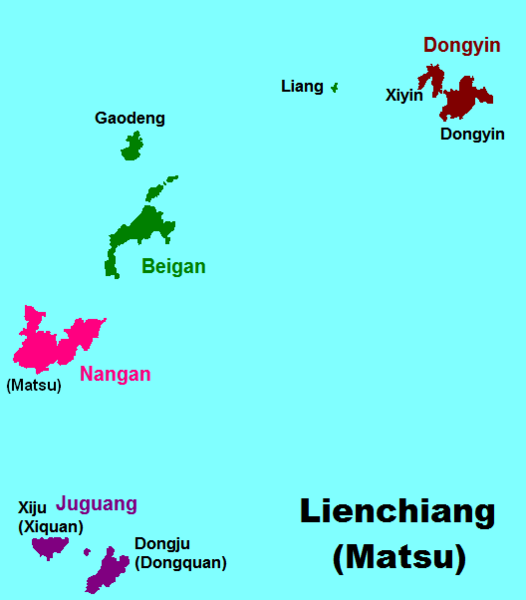
File:Lienchiangadm.PNG
Matsu: not to scale - Dongyin and Juguang further from other
two main islands.
The Matsu (馬祖 Matzu, officialy Lienchiang County) Islands are a group of Taiwan-controlled Islands 10km from the Chinese coast NW of Taiwan. The two main islands are Nankan (南竿) and Beigan (北竿 Peikan). It is possible to fly to Beigan and Nangan from Taipei (Domestic, Songshan) Airport with Uni-air. Regular small ferries all day between Beigan and Nangan, fewer to Donyin (東引) (best by Taima Ferry on route to/from Keelung) and the somewhat remoter Jyuguang (莒光). Lots of interesting sights - the most bunker-laden place in the world, quiet villages - and the civilizing presence of 7-11 stores!


I’ve started writing up some notes on good birding sites (especially at migration time) on the Matsu Islands. Tired. For now, I suggest birders scoot around a variety of places on the islands. Look out at areas of forest scrub near the small reservoirs, and the vegetable gardens near several of the villages.

NT$ 500,000 - a good start!


New birds:
Roseate Tern    Sterna dougallii  
Red-necked Phalarope    Phalaropus lobatus