Showing posts with label taiwan bird field guide. Show all posts

Sunday, July 12, 2015

Field Guide - 2nd Edition

A Field Guide to the Birds of Taiwan, 2nd edition (Chinese language).
Pleasantly surprised to be reviewing another field guide to Taiwan birds so soon. This 2015 second edition rectifies the few minor issues with last October’s first edition. I can highly recommend it to anyone birding in Taiwan. Chuck Hung and I hope to have copies available for inspection and purchase at the British Birdfair next month.


Review
Changes
Notes on sections
Supplementary notes
Known errors


That a field guide of this quality can be produced for the domestic market is a reflection of the vibrant nature of the Taiwanese bird-watching and conservation scene. There is comprehensive coverage of the avifauna of the main island, offshore islands (Matsu, Lanyu, Kinmen etc), and surrounding seas. 675 birds are fully illustrated, compact double plates for escapees and difficult species comparisons. Six years in preparation, the wait was worth it and the Society is to be congratulated for producing such a useful book. The artwork is very good and of a standard meeting, or exceeding, that of international publishers. No other book illustrates the current 27 endemics, 56 endemic subspecies, other resident/migrant species and relevant subspecies better.


While the main text is in Chinese, the 185 excellent painted plates will possibly also make it the default guide for foreign birders to Taiwan. All species are are labeled in English, and non-Chinese readers can make good use of highlighted key marks, size indicators, and the English/scientific name index. Some foreign birders may still wish to supplement it with Mark Brazil's The Birds of East Asia (now available as as an e-book with embedded calls), birding reports, the latest Taiwan checklist, and Liao Pensing’s rather good photographic books.


Large pocket size, a reasonable 614 grams - visiting birders may wish to remove some redundant introductory pages in Chinese to bird families, topography, etc. Well bound and printed, flexi-cover. Taxonomy follows Clements 2014. Chinese-language species description text is on the pages facing the 3-4 species per page plates. The uniformity of a single artist, and tasteful background habitat artwork worked for me, but may not be to everyone's taste. An English-language version is planned, but this could take some time, and should not hold back anyone considering visiting Taiwan from purchasing this book.


A Field Guide to the Birds of Taiwan, 2nd edition (Chinese language). By Mu-Chi Hsiao (main author) and Cheng-Lin Li (artist). 2015. Taipei Wild Bird Society and Taiwan Forestry Bureau. 439 pages; 185 colour plates. ISBN 978-986-04-4453-7 List price NT$ 1,200.


Changes from first edition:
Improved English name of the book.
Several new species added - including the now famous Siberian Crane.
Several labeling typos fixed.
A couple print color issues resolved.
Distribution maps for endemics enlarged and made useful.
A new combined English/Scientific/family index.
Comes with a magnifier bookmark.
A better cover with good plastic sleeve.
Inside cover quick index to families.
No Japanese-language index. Not sure why.
No CWBS checklist. Was somewhat redundant.
Slightly lighter. (almost half of Brazil’s BofEA)
Various Chinese-language errors fixed.
Various other minor additions and adjustments.
No change to the small font size of labels - I will manage.


Notes for non-Chinese readers:
The one weakness for foreign birders is the main text is in Chinese - but English and Scientific names given, and most relevant  labels in English.


Book Sections


Page 1 to 42 are in in Chinese only. To reduce weight, some of you may wish to remove these pages.
Page 2-5. Introductions from the leaders of the Bird Society, Forestry Bureau, main author and artist.
Page 6-7. How to use the book. Right-hand side of page 7 has a guide to pronunciation of uncommon words (Chinese speakers/learners may find this useful).
Page 8-13. Contents.
Page 14-20. A well-written introduction to birds and classification.
Page 20-23. Avian Topography and other terminology.
Page 24-43. Family descriptions.
Page 44-417. Individual species description and illustration.
Page 418-421. Exotic species.
Page 422-426. Index of Chinese names.
Page 427-438. Index of English and scientific names.
Page 439. References.


Page by page supplementary notes:
Illustrations needing more labeling in English. Tell me of any others to include. Unless otherwise mentioned, I’m moving top to bottom, left to right.


P 50. Tundra Swan, Whooper Swan.


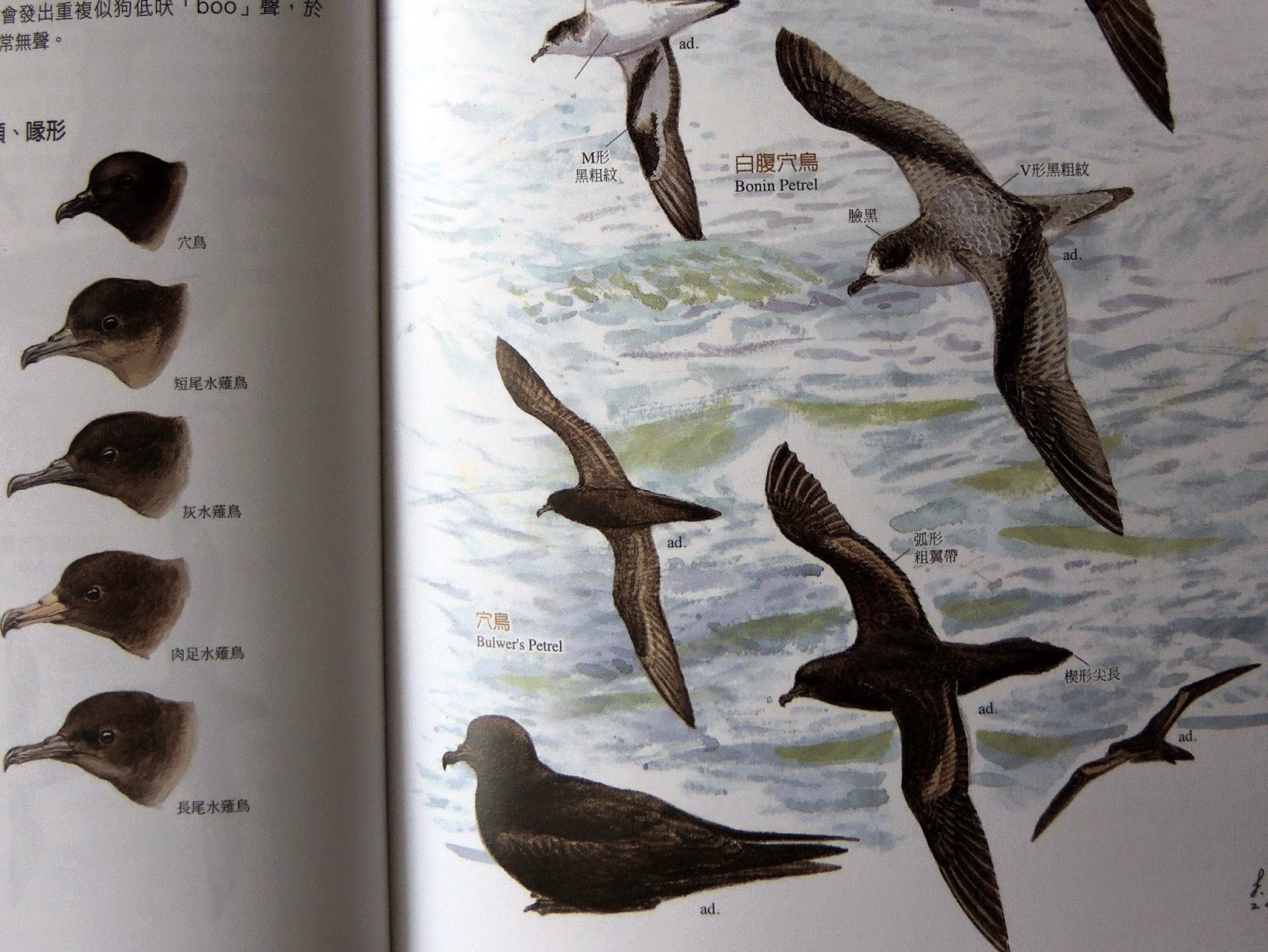
P 80. Bulwer’s Petrel, Short-tailed Shearwater, Sooty Shearwater, Flesh-footed Shearwater, Wedge-tailed Shearwater.


P 88. Great Cormorant, Japanese Cormorant.


P 96. Egret, Night Heron, Ibis, Spoonbill, Crane, Crane.


P 102. Pacific Reef-Heron, Little Egret, Chinese Egret, Cattle Egret, Intermediate Egret, Great Egret.


P 120. Crested Serpent-Eagle (shallow ‘v’), Osprey (shallow ‘m’), Imperial Eagle, Mountain Hawk Eagle, Oriental Honey-buzzard, Eastern Marsh-Harrier and Common Buzzard (shallow ‘v’), Black Eagle, falcon.


P 128. Eurasian Hobby (top left), Amur Falcon (middle), Peregrine Falcon (bottom left), Merlin (top right), Eurasian Kestrel (bottom right).


P 140. Demoiselle Crane, Common Crane.


P 159. Grey-tailed Tattler: white supercilium extending beyond eye. Wandering Tattler: supercilium only in front of eye, contrasts with eyestripe.


P 160. Common Redshank, Spotted Redshank.


P 167. Whimbrel, Little Curlew.


P 196. Laughing Gull, Franklin’s Gull.


P 214. Non breeding plumage: Gull-billed Tern, Common Tern, Little Tern, Whiskered Tern.


P 216. Non-breeding plumage: Black Tern, White-winged Tern, Whiskered Tern.


P 258. Ryukyu Minivet, Ashy Minivet, Brown-rumped Minivet.


P 264. Long-tailed Shrike schach subspecies intermediate and dark morph on Kinmen Islands.


P 280. Skylark, Oriental Skylark.


P289. Bottom left Light-vented Bulbul: Dongyin (a Matsu island) race - white bandana small, darker breast.  


P 298. Dusky Warbler: supercilium front white, buff behind, bill fine; Radde’s Warbler: supercilium front broader, rear finer, bill short and thick. Yellow-streaked Warbler: supercilium uniform, bill more pointed and finer than Radde’s.  


P 353. Flying birds are Black Redstart, Daurian Redstart.


P 384. Inset shows median coverts of Richard’s Pipit and Blyth’s Pipit.


Known errors:
(these are rare exceptions - otherwise very accurate!)


Page 280 & 281. Oriental Skylark subspecies should be spelled wattersi not wattonsi.
Page 362 & 363. Scaly Thrush subspecies is toratsugumi not toratugumi.
Page 142. The range map for Siberian Crane is wrong. Much more restricted to Poyang and Russian Arctic


Corrections to Index:
Clanga clanga 110
Eagle, Black 110
(to add) Bonelli’s 112
Hawk-Eagle, Mountain 110
Honey-Buzzard, Oriental 112
Ictinaetus malayensis 110
Nisaetus nipalensis 110
Pernis ptilorhynchus 112
Serpent-Eagle, Crested 112
Spilornis cheela 112
Spotted-Eagle, Greater 110 (from Spotted, Greater 112)


Sunday, November 30, 2014

Field Guide - a simple supplement.

 First Edition. See my review of the second edition of this book.

Supplement to the new Taiwan Bird Field Guide.


This is a supplement to the Chinese-language ‘Field Guide of Wild Bird in Taiwan’ published October 2014 by Taipei Wild Bird Society and the Forestry Bureau. ISBN 978-986-04-2555-0 My aim here is to make this already excellent book a bit more useful for non-Chinese readers.


This is version 2 published here January 12th 2015. Later versions will hopefully include more relevant details. Feel free to send suggestions.


Consider combining this field guide with Mark Brazil’s Birds of East Asia (now available as as an e-book with embedded calls), birding reports, the latest Taiwan checklist, and Liao Penshing’s photo books.


  1. Book sections.
  2. Known errors.
  3. Page by page.
  4. Better Index.


Book Sections:

Page 1 to 42 are in in Chinese only. Some of you may wish to remove these pages.
Page 2-5. Introductions from the leaders of the Bird Society, Forestry Bureau, main author and artist.
Page 6-7. How to use the book. Right-hand side of p7 has a guide to pronunciation of uncommon words (Chinese speakers may find useful).
Page 8-13. Contents.
Page 14-19. An introduction to birds and classification.
Page 20-23. Avian Topography.
Page 24-43. Family descriptions
Page 44-417. Individual species description and illustration.
Page 418-419. Exotic species.
Page 420-423. Index of Chinese names.
Page 424-433. Index of English and scientific names.
Page 434-439. Index of Japanese names.
Page 440-450. Checklist of Taiwan birds indicating endemic and protected status (in Chinese)
Page 451. References.


Known errors:
 
(these are the rare exceptions - otherwise very accurate!)
Page 75. The illustration of Short-tailed Albatross is mislabeled as Long-eared Owl.
Page 75. Red-necked Grebe nonbreeding illustration mislabeled as juvenile.
Page 87. Masked Booby ad. nonbreeding should be ad.
Page 116. Correct dimensions for Crested Goshawk should be L 30-46 cm, M 224-450 g, W 54-79 cm.
Page 128. Eurasian Kestrel subspecies should be interstinctus, not linnaeus or innaeus.
Page 155. Terek Sandpiper back black...tbc
Page 185. Buff-breasted Sandpiper flight tail shape seems odd.
Page 279. Bird in the middle should be labeled as Lesser Short-toed Lark.
Page 282. Grey-throated (as opposed to Gray-throated) Martin IS CORRECT...because...I’m British! See also Page 367 Grey-sided Thrush.
Page 295. The two Japanese Bush-warbler subspecies labels should be reversed.
Page 333. Yellow Tit (and Green-backed) is printed too orange.
Page 361. Blue Whistling-Thrush subspecies is correctly spelled caeruleus.
Page 383. Western Yellow Wagtail subspecies plex should read plexa.
Page 401. Black-faced Bunting subspecies should be spelled personala not personata.
Page 411. Illustrated Eurasian Bullfinch is pyrrhula subspecies.
Page 413. The illustration of Japanese Grosbeak is mislabeled as Common Rosefinch.


Page by page notes:
 
(to illustrations needing more labeling in English)
Unless otherwise mentioned, I’m moving top to bottom, left to right.


P 50. Tundra Swan, Whooper Swan.


P 80. Bulwer’s Petrel, Short-tailed Shearwater, Sooty Shearwater, Flesh-footed Shearwater, Wedge-tailed Shearwater.


P 88. Great Cormorant, Japanese Cormorant.


P 96. Egret, Night Heron, Ibis, Spoonbill, Crane, Crane.


P 102. Pacific Reef-Heron, Little Egret, Chinese Egret, Cattle Egret, Intermediate Egret, Great Egret.


P 110. Osprey (shallow ‘m’), White-bellied Sea-Eagle, Falcon, Crested Serpent-Eagle (shallow ‘v’), Mountain Hawk Eagle, Oriental Honey-buzzard, Eastern Marsh-Harrier and Common Buzzard (deep ‘v’), Black Eagle.


P 128. Eurasian Hobby (top left), Amur Falcon (middle), Peregrine Falcon (bottom left), Merlin (top right), Eurasian Kestrel (bottom right).


P 140. Demoiselle Crane, Common Crane.


P 142. (top, then anti-clockwise) Demoiselle Crane, Hooded Crane, White-naped Crane, Red-crowned Crane, Common Crane.


P 159. Grey-tailed Tattler: white supercilium extending beyond eye. Wandering Tattler: supercilium only in front of eye, contrasts with eyestripe.  


P 160. Common Redshank, Spotted Redshank.


P 196. Laughing Gull, Franklin’s Gull.


P 214. Non breeding plumage: Gull-billed Tern, Common Tern, Little Tern, Whiskered Tern.


P 216. Non-breeding plumage: Black Tern, White-winged Tern, Whiskered Tern.


P 258. Ryukyu Minivet, Ashy Minivet, Brown-rumped Minivet.


P 264. Long-tailed Shrike schach subspecies intermediate and dark morph on Kinmen Islands.


P 280. Skylark, Oriental Skylark.


P289. Bottom left Light-vented Bulbul: Dongyin (a Matsu island) race white bandana small, darker breast.  


P 298. Dusky Warbler: supercilium front white, buff behind, bill fine; Radde’s Warbler: supercilium front broader, rear finer, bill short and thick. Yellow-streaked Warbler: supercilium uniform, bill more pointed and finer than Radde’s.   


P 353. Flying birds are Black Redstart, Daurian Redstart.


P 384. Inset shows median coverts of Richard’s Pipit and Blyth’s Pipit.


Better Index.

A more user friendly index is now available on the Taipei Bird Society’s website here. In excel format - can someone help me reformat this into handy printable version? The section for combined English/Scientific names is under the middle tab.

Monday, October 27, 2014

The new Taiwan Bird Field Guide

First Edition. See my review of the second edition of this book.

The new field guide (in Chinese) for Taiwan birds has just been published. Confident it will be the default guide for any birder here. See details below for purchasing.
 
Years in the making, sample books were available for inspection at the Taipei Birdfair this past weekend, actual delivery only starts November 7th.  Photos taken with cell-phone - and authors' permission. First impressions:


First thing to emphasize is that the main text is in Chinese (remember 99% of birding done here is by local birders). As well as the painted plates, non-Chinese readers can make use of highlighted key marks and size indicators. Each species and variant is labeled in English. Some foreign birders may still wish to supplement it with Mark Brazil's The Birds of East Asia, Liao Bensing’s rather good photographic books, and the latest checklist. Without having much time to carefully study/use it yet, the artwork seems very good and of a standard meeting, or exceeding, that of international publishers. No other book illustrates the endemics and relevant endemic/resident/visiting subspecies better. Well done to all involved in producing this!


The only fault I found is the clumsy English title - thankfully the focus was on the internal content! Range maps of little use.


Comprehensive coverage of main island and offshore islands (Matsu, Lanyu, Kinmen etc).
637 birds fully illustrated, with another 11 escapees in a condensed double plate.
Satisfactory combined scientific/English name index.
Published by Taipei Wild Bird Society with the Forestry Bureau. ISBN 9789860425550
Field Guide of Wild Bird in Taiwan [sic] Mu-Chi Hsiao (main author), Cheng-Lin Li (artist).
Large pocket size, 680 grams (foreign birders may wish to remove pages in Chinese introducing bird families, taxonomy etc).
Well bound, printed on quality paper etc. Flexible cover, 451 pages.


It is available from Taipei Bird Society and other bird societies for around NT$ 1,200. I am happy to mail it directly worldwide. UK, US, AUS etc US$ 58 (or UK£37); east Asia (Sing, Japan, HK etc) US$ 49. This includes packing, airmail postage (expect arrival within 1 week to the UK), and a useful map of the country. Send payment to PayPal account sinoflump@hotmail.com including your correct address.

To make this book more useful for foreign birders - in a month or so I will prepare a supplement translating key text to tricky species etc. Suggestions welcome.